 English
  cn
cn  de
de  es
es  fr
fr 
Rod lenses’ optical performance is similar to cylindrical lenses, incident collimated light passes through the polished circumference of the rod lens will be formed into a line. Variety of laser and imaging applications utilize rod lenses as line generator optics.
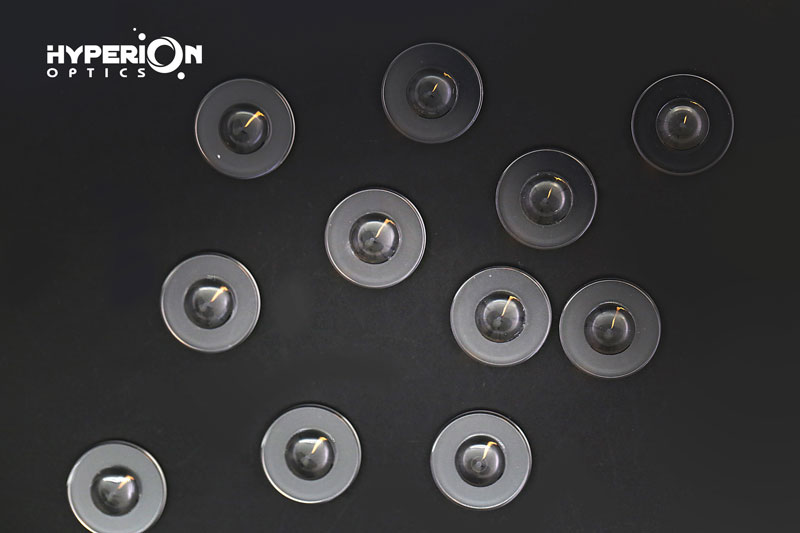
Hyperion Optics provides a range from micro sized rod lenses manufactured with variety of optical materials including fused silica ultra-violet version for OEM applications, also custom sizes and variations in surfaces requirement additional coatings are available upon request.
Engineers normally find that the optical uniformity varies from center to the two ends on a rod lens, Hyperion Optics insists polishing circumference on a longer length rod substrates then slice and ground the ends to tolerance to yield a better polishing result which would impact on the overall line uniformity in actual use.
|
Lens Type |
Rod Lens |
Length Tolerance |
+ 0.00 / -0.10 |
|
Glass Type |
BK7 |
Diameter Tolerance |
+ 0.00 / -0.03 |
|
Dimension Unit |
mm |
Surface Quality |
40-20 |
|
Edge Bevel |
None |
Clear Aperture |
90% |
|
Coating |
Uncoated |
||
|
* All dimensions are in mm |
|||




 Call us on:
  Email us:
  9B-4F, No.1 Qingnian Road Liando U Valley,Yuhua International Wisdom Valley, Nanjing, 210039 China