 English
  cn
cn  de
de  es
es  fr
fr 
The difference between capturing an image and collecting useful visual data often depends on how effectively an optical system covers and represents the target environment. In automated inspection, a limited viewing angle can create blind areas, increase camera deployment requirements, and make complex visual tasks more difficult to manage. As industrial systems become more automated, the ability to capture wider scenes while maintaining reliable image quality has become increasingly important.
A fisheye lens provides a unique solution by offering an extremely wide field of view within a compact optical structure. Unlike conventional lenses that mainly focus on minimizing perspective distortion, a fisheye lens is designed to capture broader visual information and support applications where large-area coverage is essential. Through advanced fisheye lens design, engineers can optimize the relationship between viewing angle, image quality, and system requirements.
Developing an effective fisheye lens for machine vision requires more than simply increasing the field of view. Optical designers must consider factors such as sensor compatibility, working distance, distortion characteristics, and inspection accuracy. With professional optical design and manufacturing capabilities, Hypoptics develops customized lens solutions that help industrial imaging systems achieve stable and efficient performance.
Machine vision systems often operate in environments where capturing complete visual information is challenging. Production equipment, robotic workspaces, large components, and moving objects may require a wider perspective than traditional optical systems can provide. A fisheye lens helps overcome these limitations by expanding the camera’s field of view and allowing more information to be captured in a single image.
The advantage of a fisheye lens is not only the ability to see a larger area. In automated inspection systems, a wider perspective can simplify camera positioning, reduce blind spots, and improve the efficiency of image acquisition. This is particularly valuable when inspection targets have irregular shapes or when installation space is limited.
However, wide-angle imaging introduces its own optical challenges. As the viewing angle increases, distortion and uneven image performance may become more noticeable. A professional fisheye lens design focuses on controlling these effects through optimized optical structures, carefully calculated lens surfaces, and appropriate correction strategies.
By balancing wide-area coverage and optical performance, modern fisheye optics provide machine vision systems with more complete visual information while maintaining sufficient image quality for automated analysis.
Large-area inspection is one of the most important application areas for a fisheye lens. In manufacturing facilities, robotics environments, and automated monitoring systems, capturing a wider scene can improve inspection efficiency while reducing the complexity of camera deployment.
Traditional lenses often require multiple cameras to monitor large spaces because their viewing angles are relatively limited. Although additional cameras can increase coverage, they also introduce challenges such as more complicated installation, calibration, and maintenance requirements.
A well-developed fisheye lens design provides a different approach by enabling broader scene capture with a single imaging system. This makes fisheye lenses suitable for applications where understanding the overall environment is more important than focusing on a narrow area.
For example, automated inspection systems can use fisheye optics to monitor larger production zones, observe equipment operation, or capture complex scenes where object movement and spatial relationships need to be analyzed. By improving visual coverage, these lenses can support more efficient inspection workflows.
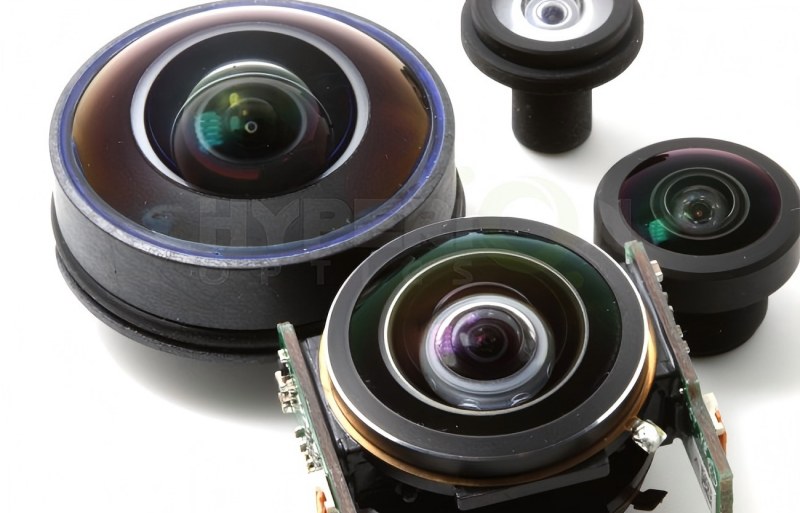
The challenge of developing a high-performance fisheye lens lies in balancing an extremely wide viewing angle with practical image quality requirements. A larger field of view allows more information to be captured, but it also creates greater demands on optical correction and image consistency.
An advanced fisheye lens design evaluates multiple optical factors, including distortion control, resolution distribution, light transmission, and sensor matching. Instead of simply removing distortion, engineers often optimize the distortion pattern according to the intended application so that image information remains predictable and useful.
| Optical Feature | Conventional Lens | Fisheye Lens |
|---|---|---|
| Field of view | Designed for relatively narrow viewing areas | Provides extensive scene coverage |
| Distortion characteristics | Usually minimized during optical design | Managed and optimized for wide-angle imaging |
| Large-area inspection | May require multiple cameras | Can capture broader environments with fewer systems |
| Installation flexibility | Requires precise positioning | Offers greater coverage flexibility |
| Application focus | Suitable for standard imaging tasks | Suitable for wide-area monitoring and inspection |
Through precise optical simulation and engineering optimization, a suitable fisheye lens design can deliver the required viewing coverage while maintaining image quality that meets machine vision requirements.
Automated visual inspection depends on reliable image capture. Even advanced cameras and algorithms may struggle if the optical system cannot provide sufficient coverage or consistent image information. A fisheye lens helps improve inspection efficiency by allowing systems to observe larger areas within a single image frame.
In robotic inspection, a wide-angle lens can help maintain visibility when objects move through different positions. In production monitoring, it can support continuous observation of larger areas without requiring frequent camera adjustments.
The effectiveness of a fisheye lens depends on selecting an optical configuration that matches the specific application. Factors such as sensor size, lighting conditions, working distance, and image processing requirements all influence the final system performance.
Choosing suitable optical components is an important step when developing a reliable machine vision system. Hypoptics provides customized optical solutions for different imaging requirements, including lenses and related components designed to support industrial vision applications where accuracy and consistency are essential.
Engineers looking for suitable optical configurations can explore Hypoptics' optical components to understand available solutions for different imaging systems and integration requirements.
Integrating a fisheye lens into an automated inspection system requires careful evaluation of both optical and system-level requirements. Selecting a lens based only on viewing angle may not guarantee the desired inspection performance.
Sensor compatibility is one of the first considerations because the sensor format directly affects how much of the lens image can be captured. Working distance and mounting conditions also influence whether a specific fisheye lens design can achieve the required coverage and clarity.
Image processing requirements should also be considered during system development. Some applications require software-based distortion correction, while others benefit from preserving the original wide-angle characteristics of fisheye imaging. The best results are usually achieved when optical design and image processing strategies are considered together.
Manufacturing consistency is another important factor. A reliable fisheye lens design requires precise production processes to ensure stable performance across different lens units, especially in industrial environments where long-term reliability is essential.
Industrial imaging is moving toward systems that can collect more information, operate with greater flexibility, and support increasingly intelligent analysis. This trend is creating new opportunities for wide-angle optical technologies such as the fisheye lens.
Advances in optical simulation, precision manufacturing, and lens materials are allowing engineers to develop more capable fisheye lens design solutions. These improvements help fisheye lenses support applications that require broader coverage without sacrificing the reliability needed for automated decision-making.
As machine vision becomes more closely connected with artificial intelligence and automated control systems, high-quality image acquisition will remain a fundamental requirement. A properly designed fisheye lens can provide valuable visual data for intelligent inspection, robotics, and industrial monitoring applications.
With experience in customized optical development, Hypoptics works with customers to create lens solutions suited to specialized imaging challenges. Whether a project requires a specific field of view, customized optical structure, or integration support for an automated inspection system, engineers can discuss their requirements with the Hypoptics team through its optical consultation service.
A fisheye lens plays an important role in machine vision and automated inspection systems by expanding visual coverage while maintaining efficient optical performance. Through advanced fisheye lens design, engineers can balance wide field of view, image quality, and application requirements to create more effective imaging solutions.
As industries continue to adopt smarter automation technologies, fisheye optics will become increasingly valuable for large-area inspection, robotic vision, and complex imaging environments. By combining optical expertise with precision manufacturing, Hypoptics supports customers in developing customized lens solutions that improve imaging efficiency and system reliability.
A fisheye lens provides a very wide field of view, allowing machine vision systems to capture larger areas with fewer cameras and more flexible installation options.
A fisheye lens naturally produces a wide-angle projection effect, but advanced fisheye lens design can optimize distortion according to application requirements.
They help systems monitor larger areas, reduce blind spots, and improve inspection efficiency in complex environments.
A professional fisheye lens design balances viewing angle, optical correction, resolution, and sensor compatibility to maintain usable image performance.
Yes. Fisheye lenses can be customized based on factors such as sensor size, working distance, field of view, and inspection requirements.
Machine vision, robotics, automated inspection, surveillance, and scientific imaging systems commonly use fisheye lenses for wide-area image capture.




 Call us on:
  Email us:
  9B-4F, No.1 Qingnian Road Liando U Valley,Yuhua International Wisdom Valley, Nanjing, 210039 China