 English
  cn
cn  de
de  es
es  fr
fr 
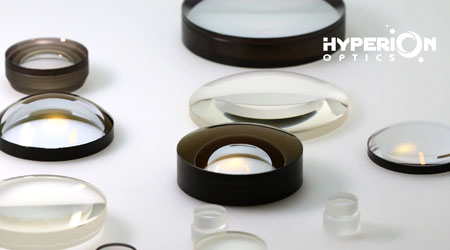
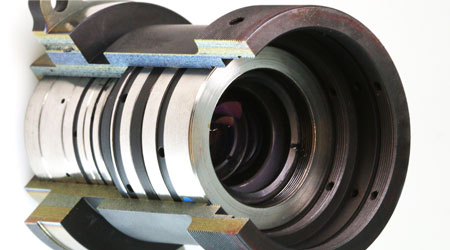
A triplet lens is a compound lens consisting of three single lenses. The triplet design is the simplest to give the required number of degrees of freedom to allow the lens designer to overcome all Seidel aberrations.
Calcium Fluoride and UV Fused Silica Elements
Broadband Color-Corrected Design from 193nm to 1000nm
Ideal for Fluorescence and Spectroscopy Applications
Designed with broadband applications in mind, our UV-to-NIR corrected lenses provide a consistent focal length (see chromatic shift information below) and spherical aberrations free performance for wavelengths ranging from 193nm to 1000nm. Manufactured with premier grades of Calcium Fluoride and Fused Silica, these infinite-conjugate triplets are perfect for imaging applications utilizing a wide spectrum of wavelengths. Typical uses include fluorescence research in which the emitted light is in the visible and near infrared regions of the spectrum or in dual-pass systems in which the same lens is used to illuminate the excitation material as well as collect the emissions from it.
COMMERCIAL GRADE | FACTORY STANDARD | PRECISION GRADE | |
Diameter Tolerance(mm) | ±0.05 | ±0.03 | ±0.0125 |
Center Thickness(mm) | ±0.01 | ±0.03 | ±0.025 |
Radius (%) | ±1% | ±0.5% | ±0.3% |
Focal Length Tolerance (%) | ±3% | ±1% | ±0.5% |
Cosmetic(MIL-C-13830A) | 100-80 | 40-20 | 10-5 |
Figure Tolerance in λ(Pow/irreg) | 3 - 1 | 2 - 1/4 | 1 - 1/10 |
Centration (Arc min) | 6 | <3 | <1 |
Dia. To Thick Ratio | 9~50:1 | ||
Coating (T% avg) | 96-98% | 99% | 99.5% |
Materials | |||
For extremely precision-sensitive system requirements, and achromatic lens buys please contact us for further new information on optical materials, our engineers are more than happy to evaluate your design, and our experiences of manufacturing input help to define the most appropriate tolerances.




 Call us on:
  Email us:
  9B-4F, No.1 Qingnian Road Liando U Valley,Yuhua International Wisdom Valley, Nanjing, 210039 China