 English
  cn
cn  de
de  es
es  fr
fr 
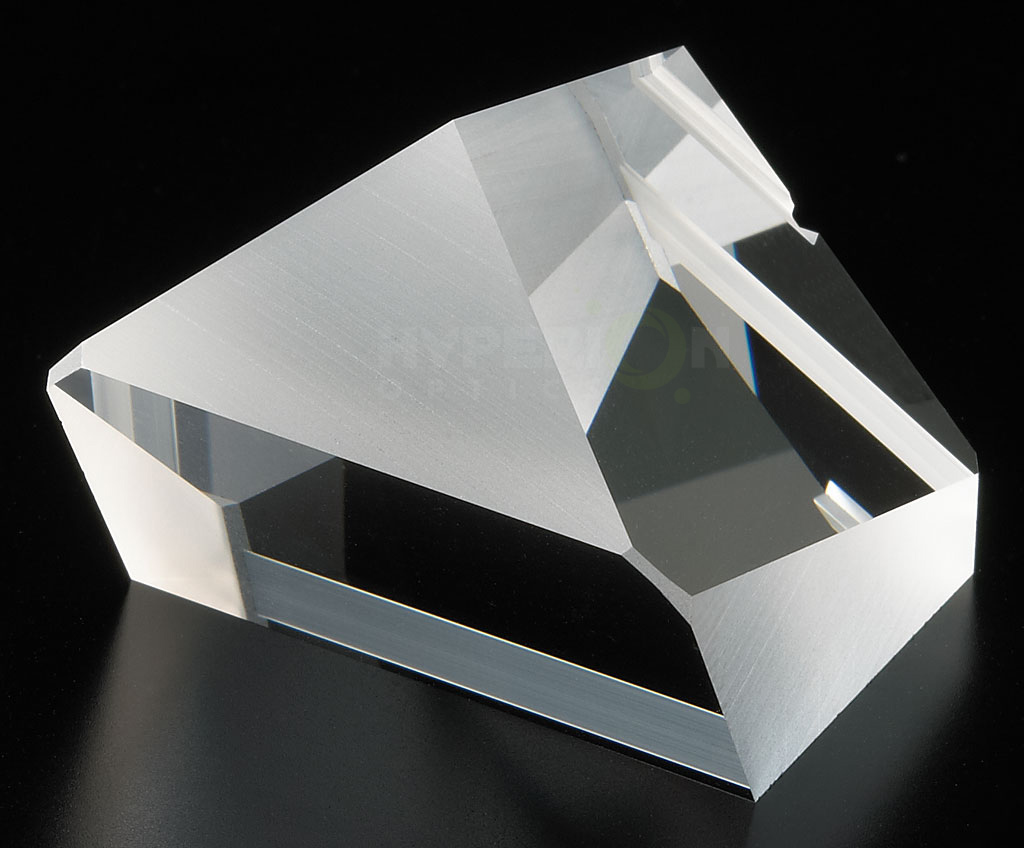
Penta Prisms are used to define right angles in optical systems. Penta Prisms, which provide right handed images, feature a ray deviation of 90°. Penta Prisms are five-sided prisms and unaffected by slight movements. Edmund Optics offers a variety of Penta Prisms for optimal performance in the Ultraviolet (UV), Visible, or Infrared (IR) spectrums.
The penta prism will neither invert nor reverse the image. Penta prisms are extremely useful in alignment systems as they define a right angle very precisely and independently of angle of incidence. Rays entering one face emerge from the adjacent face at precisely 90 deg after they have undergone two reflections inside the prism for a total of 270 deg. The penta prism acts as a turning mirror which is insensitive to alignment.
Penta prism is often used in Plumb Level, Surveying, Alignment, Range finding and Optical Tooling
Factory Standard – Contact us for manufacturing limit or custom specifications
Precision series: up to 2 arc seconds






 Call us on:
  Email us:
  9B-4F, No.1 Qingnian Road Liando U Valley,Yuhua International Wisdom Valley, Nanjing, 210039 China