 English
  cn
cn  de
de  es
es  fr
fr 
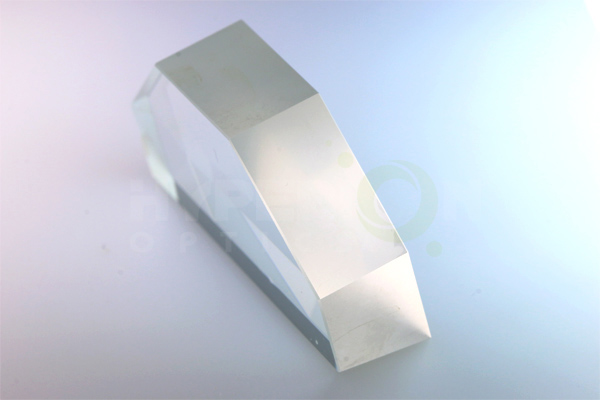
Dove prisms are used as a reflective prism, inverting the image. The Dove prism is shaped from a truncated right-angle prism. Normally, dove prisms are used in the parallel optical path based on the critical angle principle to meet total internal reflection with a limited FOV.
A beam of light entering one of the sloped faces of the prism undergoes total internal reflection from the inside of the longest (bottom) face and emerges from the opposite sloped face. Images passing through the prism are flipped, and because only one reflection takes place, the image is inverted but not laterally transposed.
A beam of light entering the sloped faces undergoes total internal reflection from the bottom surface and emerges from the opposite sloped face. Also interestingly, when Dove prisms optical are rotated along the longitudinal axis, the image rotates at twice the rate of the prism, which has applications in fields such as interferometry, astronomy, and pattern recognition. Dove prisms can also be used as right-angle prisms with sloped faces HR HR-coated.
Hyperion Optics supplies standard and custom-made dove prisms according to your requirements; please refer to the following spec grid for further capability study. Talk to our technicians today to find out the best tolerance fit that works with your application.
Dove Prism | COMMERCIAL GRADE | FACTORY STANDARD | PRECISION GRADE |
Dimension Tolerance(mm) | ±0.05 | ±0.03 | ±0.0125 |
Angle Tolerance( Arc min) | 5‘ | 3’ | 1‘ |
Cosmetic(MIL-C-13830A) | 80-50 | 40-20 | 10-5 |
Flatness @632.8 nm | 2 Lambda | 1/2 Lambda | 1/10 Lambda |
Coating (T% avg) VIS | 96-98% | 99% | 99.5% |
Coating (R% avg) VIS | 96-98% | 99% | 99.5% |
Materials | Optical Glass, fused silica | ||





 Call us on:
  Email us:
  9B-4F, No.1 Qingnian Road Liando U Valley,Yuhua International Wisdom Valley, Nanjing, 210039 China