 English
  cn
cn  de
de  es
es  fr
fr 
In the precision-driven world of optical engineering, choosing the right reflective surface is rarely a one-size-fits-all decision. Whether you are developing high-resolution imaging systems, laser cavity optics, or solar energy concentrators, the geometry of your mirror dictates the performance of your entire system. Among the most common debates for optical designers is the choice between spherical and parabolic surfaces.
At Hyperion Optics, we have spent over 17 years refining the art of high-precision manufacturing. Understanding when to stick with a cost-effective spherical mirror and when it is time to upgrade to a high-performance solution is vital. If you are looking to buy parabolic mirror hardware for a new project, this guide will help you navigate the technical trade-offs.
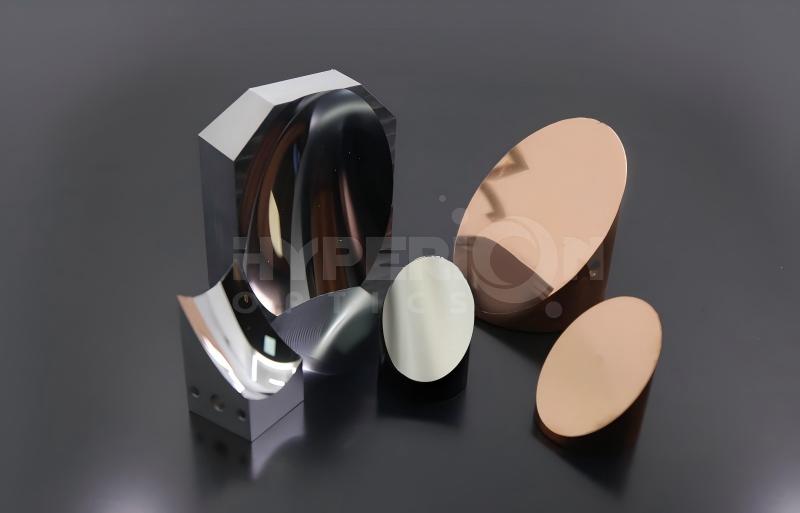
Spherical mirrors are the most common reflective components found in optics because they are relatively straightforward to manufacture. By grinding a substrate into the shape of a sphere, you create a mirror that reflects light consistently regardless of the incident angle relative to its center of curvature.
The primary disadvantage of a spherical surface is spherical aberration. Because the curvature of a sphere is uniform, light rays striking the edge of the mirror do not focus at the same point as rays striking the center. This results in a blurred or "smeared" focal point, which limits resolution in high-performance applications. While spherical mirrors are excellent for general-purpose lighting or low-precision imaging, they struggle when extreme focus precision is required.
As projects demand higher resolution and better light collection efficiency, engineers often decide it is time to switch. A parabolic mirror is specifically shaped as a segment of a parabola. Unlike its spherical counterpart, a parabolic design forces all parallel incident light rays—regardless of where they hit the mirror surface—to converge at a single, perfect focal point.
The most significant benefit of a parabolic design is that spherical aberration is theoretically zero. This makes them the gold standard for collimating parallel light beams or focusing point sources with extreme accuracy.
Hyperion Optics frequently manufactures off-axis parabolic reflectors. These mirrors represent a portion of a "parent" paraboloid, allowing the focal point to be physically separated from the incident beam path. This off-axis geometry is essential for systems where you do not want the detector or instrument to block the incoming light, a common challenge in advanced laser systems and high-end telescopes.
Selecting the correct component depends on your application’s sensitivity to aberration and your budget constraints.
| Feature | Spherical Mirror | Parabolic Mirror |
|---|---|---|
| Spherical Aberration | High (Significant) | Zero (Corrected) |
| Manufacturing Cost | Low | Higher (Precision Required) |
| Primary Advantage | Economic/General Purpose | Precision/High Efficiency |
| Focusing Capability | Multi-point blur | Single, sharp focal point |
| Best Application | Lighting, simple imaging | Lasers, Astronomy, Spectroscopy |
Deciding to search for a parabolic mirror for sale is usually driven by specific performance bottlenecks in your existing setup. Consider making the switch if your current system experiences the following:
Resolution Limits: If your imaging sensor cannot achieve the desired sharpness due to focal blurring.
Laser Divergence: If you are unable to collimate your laser beam tightly enough for long-distance transmission.
Complex Beam Paths: If you require an off-axis configuration where the light source and detector must be positioned outside the main beam path.
UV to IR Demands: High-performance optics often require specialized substrates and coatings. We offer custom mirrors for wavebands ranging from UV (200nm) to IR (40µm).
At Hyperion Optics, we pride ourselves on delivering optical components that meet the strictest industrial standards. Our manufacturing process for parabolic mirrors utilizes high-quality metal substrates, such as aluminum, which are then coated with enhanced aluminum, silver, or gold to optimize reflectivity.
Every mirror is individually tested by skilled technicians in our state-of-the-art metrology lab. We understand that when you buy parabolic mirror solutions from us, you are not just buying a piece of glass or metal; you are investing in the precision required for your system to succeed. We ensure that every part—whether for a standard off-the-shelf requirement or a highly complex custom off-axis design—meets your precise specifications.
We also invite you to explore our broader range of optical components, including our specialized Mirrors collection, which are manufactured with the same commitment to rigorous testing and performance.
The choice between spherical and parabolic surfaces is essentially a balance between budget and optical necessity. While spherical mirrors remain the workhorse for many general-purpose applications, the upgrade to a parabolic surface is essential when your project demands the elimination of aberration and the achievement of perfect focal alignment. By choosing a parabolic mirror, you are ensuring that your system operates with the highest possible signal integrity and precision.
At Hyperion Optics, we are dedicated to helping you determine the best path forward. If you have questions about which mirror design is right for your specific laser or imaging system, we are here to provide the technical backup and consultation you need. Contact our technical sales team today to discuss your requirements or request a custom quotation for your project.
Not necessarily. Parabolic mirrors are superior for precision and focus, but they are more expensive to manufacture. For general lighting or low-precision applications, spherical mirrors are often more cost-effective.
Yes, and this is a common practice. Off-axis parabolic reflectors are designed to separate the focal point from the incoming light beam path, which is critical for complex optical assemblies.
We standardly coat our metal-substrate mirrors with enhanced aluminum, silver, or gold, depending on the spectral requirements of your application, covering everything from UV to the Far-IR.
If your system requires a specific focal length, an unconventional off-axis angle, or performance in a very specific waveband, a custom parabolic mirror is likely the best choice. Our technicians will work with your prints to ensure the final product meets your exact technical needs.




 Call us on:
  Email us:
  9B-4F, No.1 Qingnian Road Liando U Valley,Yuhua International Wisdom Valley, Nanjing, 210039 China