 English
  cn
cn  de
de  es
es  fr
fr 
The performance of high-precision optical systems—from compact binoculars to complex laser alignment tools—relies heavily on the efficiency of light manipulation. At the heart of many such systems lies the roof prism, a versatile optical component designed to fold light paths or invert images with exceptional spatial efficiency. Among the most popular configurations is the amici prism, renowned for its ability to fold light at a 90° angle while maintaining correct image orientation.
However, even the most geometrically perfect amici prism will fail to deliver desired results if its surfaces are not treated with advanced thin-film coatings. At Hyperion Optics, we understand that the marriage of substrate precision and coating technology is what elevates an optical component from standard to mission-critical.
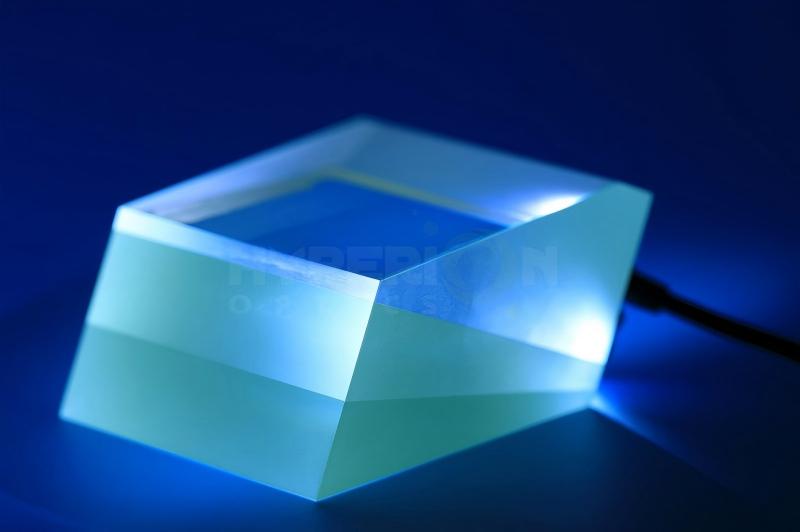
A roof prism operates by reflecting light through two internal surfaces meeting at a 90° angle. This internal reflection is the "engine" of the device. Without specialized thin-film coatings, a portion of the light is inevitably lost at each interface due to Fresnel reflection.
For an amici prism, the goal is to maximize throughput (Transmission) while ensuring the longevity of the optical surfaces. Thin-film coatings are not merely an "add-on"; they are a fundamental requirement to achieve the high signal-to-noise ratios required in modern photonics. Whether you are dealing with visible light or extended infrared wavebands, the right coating stack ensures that your light energy is transmitted rather than absorbed or scattered.
The amici prism is a specific type of roof prism that excels in applications where image orientation is paramount. Because the beam is essentially split in half—with each half reflecting off the two 90° roof faces—the manufacturing tolerance of these surfaces must be extreme.
At Hyperion Optics, we have mastered the processing technology for the right-angled roof prism. We maintain angle accuracy for 1 to 2-inch diameter prisms within 2 seconds of an arc. This geometric precision, when combined with optimized thin-film coatings, ensures that there is no compromise in image quality, ghosting, or phase shift during the beam inversion process.
Not every application requires the same level of optical perfection. Depending on your system's budget and performance requirements, selecting the correct grade is the first step toward optimization. Below is a breakdown of our standard manufacturing capabilities for prism components:
| Feature | COMMERCIAL GRADE | FACTORY STANDARD | PRECISION GRADE |
|---|---|---|---|
| Dimension Tolerance(mm) | ±0.05 | ±0.03 | ±0.02 |
| Angle Tolerance( Arc min) | 5' | 1' | 2" |
| Cosmetic(MIL-C-13830A) | 80-50 | 40-20 | 20-10 |
| Flatness @632.8 nm | 2 Lambda | 1/2 Lambda | 1/4 Lambda |
| Coating (T% avg) VIS | 96-98% | 99% | 99.5% |
| Coating (R% avg) VIS | 96-98% | 99% | 99.5% |
| Materials | Optical Glass, fused silica |
For high-end instrumentation, our Precision Grade components—utilizing Fused Silica or high-index Optical Glass—provide the lowest possible scatter and highest transmission efficiency, essential for cutting-edge amici prism integration.
Optical components are often subjected to environmental stressors, including humidity, thermal cycling, and physical handling. Thin-film coatings serve a dual purpose: they optimize transmission and protect the delicate glass surface.
For an amici prism used in outdoor or field-deployed equipment, the coating must be robust. We utilize advanced PVD (Physical Vapor Deposition) and ion-assisted deposition techniques to ensure that our coatings are not only high-performing but also resistant to environmental degradation. A properly coated roof prism from Hyperion Optics maintains its reflective and transmissive properties even after years of operation in diverse temperature ranges.
With over 17 years of experience in the industry, Hyperion Optics has become a trusted partner for companies looking to integrate custom amici prism solutions. We do not just supply glass; we provide a full-cycle engineering service that includes material selection, geometric design, and specialized thin-film deposition.
If you are currently designing an optical train and have questions regarding coating specifications, substrate compatibility, or geometric alignment, our engineering team is ready to assist. We invite you to view our full range of prism components to see the diversity of our off-the-shelf offerings or to use them as a baseline for your custom project.
Thin-film coatings are the invisible heroes of optical engineering, transforming the raw performance of an amici prism into the superior clarity expected in modern diagnostics, aerospace, and laser technologies. By focusing on both the geometric precision of the roof prism and the quality of the applied thin-film stack, designers can ensure their systems operate with maximum efficiency and reliability.
At Hyperion Optics, we remain committed to pushing the boundaries of what is possible in optical manufacturing. Whether you require a high-volume commercial batch or a single precision-engineered prototype, our facility is equipped to deliver. Let us turn your complex optical challenges into high-performance realities. Contact our technical sales team today to discuss your project requirements or to receive a competitive quotation.
An amici prism is a specific type of roof prism that folds light by 90° while simultaneously maintaining the image's original orientation, whereas a standard right-angle prism would invert the image.
Coatings significantly reduce surface reflection losses (Fresnel loss). Without proper anti-reflective or high-reflective coatings, light throughput decreases, and internal reflections can cause ghosting, degrading image quality.
Yes. Beyond standard visible (VIS) range coatings, we specialize in custom designs for UV (200nm) and IR (up to 40µm) applications to meet your specific spectral requirements.
The "roof" edge where the two faces meet is critical. If the angle deviates from 90°, it introduces image distortion. Our precision manufacturing ensures these angles are controlled to within 2 arc seconds to guarantee peak optical performance.




 Call us on:
  Email us:
  9B-4F, No.1 Qingnian Road Liando U Valley,Yuhua International Wisdom Valley, Nanjing, 210039 China