 English
  cn
cn  de
de  es
es  fr
fr 
A projection system is only as accurate as the optical technology that transfers visual information from the imaging source to the screen. While brightness engines, display chips, and electronic processing systems all contribute to image performance, the projection lens remains the critical component responsible for controlling focus, resolution, light distribution, and image accuracy. Through advanced projection lens design, engineers can optimize optical structures to achieve clearer details, improved brightness efficiency, and consistent image quality across different projection environments.
From traditional projection televisions to modern digital projection systems, optical technology has experienced significant evolution. The development of the lens from projection TV represents an important stage in the history of projection optics, showing how early optical solutions gradually developed into today's high-precision projection lenses used in entertainment, education, simulation, and professional visualization applications.
For optical companies such as Hypoptics, the challenge is not only creating lenses that enlarge images but also ensuring that every optical element works together to deliver stable and accurate projection performance. Understanding the principles behind projection lens design helps engineers and system developers choose suitable optical solutions based on their application requirements.
A projection lens is a precision optical assembly composed of multiple lens elements arranged to control the path of transmitted light. Unlike standard imaging lenses, projection lenses must enlarge an image significantly while preserving sharpness, brightness, and geometric accuracy throughout the projected area.
The image formation process begins when light generated by the projection engine passes through the lens system. Each optical element influences how accurately the image is reproduced on the screen. Lens curvature, element spacing, optical material selection, coating technology, and mechanical alignment all affect the final projection performance.
Modern projection lens design focuses on balancing several optical parameters. Focal length determines the relationship between projection distance and image size, while aperture structure affects how much light can pass through the system. The arrangement of different lens groups helps control distortion and maintain resolution, and optical coatings improve transmission efficiency by reducing unwanted reflections.
A successful projection lens design must maintain consistent optical performance from the center of the image to the edges. This requires advanced optical simulation, precise manufacturing processes, and detailed testing to ensure that brightness, focus, and color accuracy remain stable across the entire projection surface.
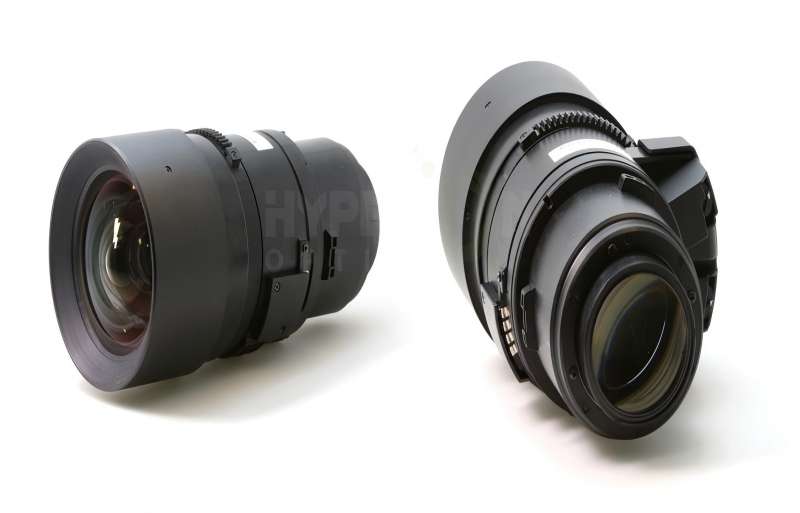
The choices made during projection lens design directly determine the quality of the final image. Different projection applications require different optical priorities. For example, cinema projection systems often emphasize high resolution and contrast performance, while portable projectors may focus on compact structure and efficient light transmission.
Resolution performance depends on how effectively a projection lens preserves fine image details. If the optical structure is not properly optimized, users may experience blurred edges, reduced sharpness, or inconsistent focus across the screen. High-quality projection lenses use carefully calculated optical configurations to maintain clarity even when projecting large images.
Brightness is another important consideration. A projection lens must transmit light efficiently while minimizing optical losses. Advanced lens coatings and optimized element arrangements improve light utilization, allowing projection systems to produce brighter images while maintaining energy efficiency.
| Optical Factor | Influence on Image Quality | Typical Design Approach |
|---|---|---|
| Resolution | Determines image detail and sharpness | Optimized lens element arrangement and high-precision optical surfaces |
| Brightness | Affects image visibility and projection efficiency | Improved aperture design and advanced optical coatings |
| Image Uniformity | Ensures consistent focus and brightness across the screen | Accurate optical alignment and balanced light distribution |
| Distortion Control | Maintains correct image shape and geometry | Multi-element correction and precision optical simulation |
Image uniformity becomes especially important in large-screen applications. A lens that performs well only at the image center may create noticeable brightness differences or edge softness. Advanced projection lens design focuses on maintaining balanced optical performance throughout the complete projection area.
One of the most challenging aspects of optical engineering is reducing optical aberrations. When light travels through a lens system, differences in wavelength and angle can cause light rays to focus imperfectly. These optical errors may reduce sharpness, affect color accuracy, or create visible image distortion.
Chromatic aberration occurs when different wavelengths of light fail to focus at the same point, potentially creating color edges around objects. Spherical aberration reduces image sharpness when light passing through different areas of a lens does not converge evenly. Distortion affects the geometric accuracy of projected images, while field curvature may cause differences in focus between the center and edges of the screen.
To overcome these problems, engineers use multiple optical elements with different characteristics and carefully optimize their positions within the lens system. Computer-aided optical simulation allows designers to evaluate performance and improve the structure before manufacturing begins.
For high-resolution projection systems, even small optical errors can become visible. Therefore, advanced projection lens design must consider not only image enlargement but also precise correction of optical imperfections to achieve reliable visual performance.
The evolution of projection technology reflects the continuous development of optical engineering. Early projection televisions required specialized optical systems to enlarge images generated by internal display technologies. The lens from projection TV played an important role in improving image projection quality during this period.
Traditional projection TV lenses were generally designed for fixed systems with specific optical requirements. As digital projection technology advanced, manufacturers needed lenses that could support higher resolutions, smaller system sizes, and more flexible installation conditions.
Modern projection systems now require optical solutions capable of supporting demanding applications such as home cinema, business presentations, simulation environments, museums, and large-scale displays. Compared with the earlier lens from projection TV, today's projection lenses provide greater optical flexibility, improved image accuracy, and better compatibility with advanced projection engines.
This transformation shows how projection lens design has developed from a basic image magnification technology into a sophisticated optical engineering discipline focused on precision, efficiency, and user experience.
One of the major challenges in modern optical development is achieving compact designs without sacrificing image quality. Smaller projection systems require lightweight and space-efficient lenses, but reducing lens size often increases the difficulty of maintaining optical accuracy.
Advanced projection lens design addresses this challenge through improved optical layouts, precision lens grouping, and optimized material selection. These approaches allow engineers to reduce system size while maintaining important performance characteristics such as resolution, brightness, and image stability.
The ideal balance between compact structure and optical performance depends on the intended application. Portable projectors may require lightweight designs, while professional projection systems may prioritize maximum optical accuracy and long-term reliability.
Selecting suitable optical components is also an important part of achieving reliable projection performance. From optical assemblies to precision components used in imaging applications, every element contributes to the final system capability. Hypoptics provides optical solutions that support different imaging requirements, and more information about available optical solutions can be explored through the Hypoptics optical components page.
Even the most advanced optical design requires precise manufacturing to achieve consistent results. A projection lens contains multiple optical elements, and small variations in surface accuracy, alignment, or assembly can influence the final image performance.
Precision manufacturing ensures that optical surfaces maintain accurate shapes, lens elements remain correctly positioned, and coatings provide stable transmission performance. These factors are essential for maintaining consistent image quality across different production batches.
For professional projection applications, reliability is particularly important because systems often operate for extended periods. Manufacturing precision helps ensure stable optical performance and reduces variations that could affect user experience.
Because projection applications often involve different optical requirements, system configurations, and performance expectations, technical communication is an important part of selecting suitable solutions. Engineers and businesses seeking further discussion about projection optics or related optical requirements can connect with Hypoptics through the contact page.
The performance of a projection system is closely connected to the decisions made during projection lens design. Optical architecture, resolution optimization, brightness control, aberration correction, compact structure development, and precision manufacturing all influence the final viewing experience.
The transition from the traditional lens from projection TV to modern precision projection optics demonstrates how optical technology continues to advance. Today's projection lenses must deliver higher image accuracy, better light efficiency, and stable performance while adapting to increasingly compact and complex projection systems.
For applications ranging from entertainment and education to industrial visualization, selecting the right optical solution is essential. Through continuous optical innovation and precision engineering, Hypoptics supports the development of reliable projection technologies that meet the demands of modern imaging systems.
Projection lens design is the process of developing optical structures that control image projection while maintaining brightness, sharpness, and accuracy.
Because the lens controls light transmission and focusing accuracy, directly influencing resolution, brightness, distortion, and image consistency.
A lens from projection TV was designed to enlarge images in traditional projection television systems and contributed to the development of modern projection optics.
Projection lenses need to reduce issues such as chromatic aberration, spherical aberration, distortion, and uneven focus.
Optical coatings reduce reflection losses, increase light transmission, and improve brightness and contrast performance.
Manufacturing accuracy ensures proper optical alignment, stable performance, and consistent image quality between different lenses.




 Call us on:
  Email us:
  9B-4F, No.1 Qingnian Road Liando U Valley,Yuhua International Wisdom Valley, Nanjing, 210039 China