 English
  cn
cn  de
de  es
es  fr
fr 
In the world of high-energy lasers, precision imaging, and advanced photonics, the performance of an optical system is only as good as the components that comprise it. Among these, dielectric mirror glass stands out as a critical element. Unlike standard metallic mirrors, these sophisticated components offer superior reflectivity, durability, and spectral control.
At Hyperion Optics, we specialize in bridging the gap between complex optical theory and practical, manufacturable solutions. Whether you are developing a high-power industrial laser or a sensitive medical imaging device, understanding the intricacies of dielectric mirror glass design is the first step toward achieving your performance benchmarks.
Dielectric mirror glass is an optical component coated with multiple thin layers of dielectric materials, such as oxides of silicon, titanium, or tantalum. Unlike metal-based coatings that rely on the absorption and reflection properties of bulk metals, these mirrors utilize the principle of multi-beam interference.
By precisely controlling the thickness and the refractive index of each layer, engineers can construct a stack that reflects specific wavelengths with extreme efficiency, often reaching reflectivity levels exceeding 99.9%. In contrast, traditional metal reflective films typically offer only 97% reflectivity. This makes dielectric mirror glass the gold standard for applications where energy loss must be minimized.
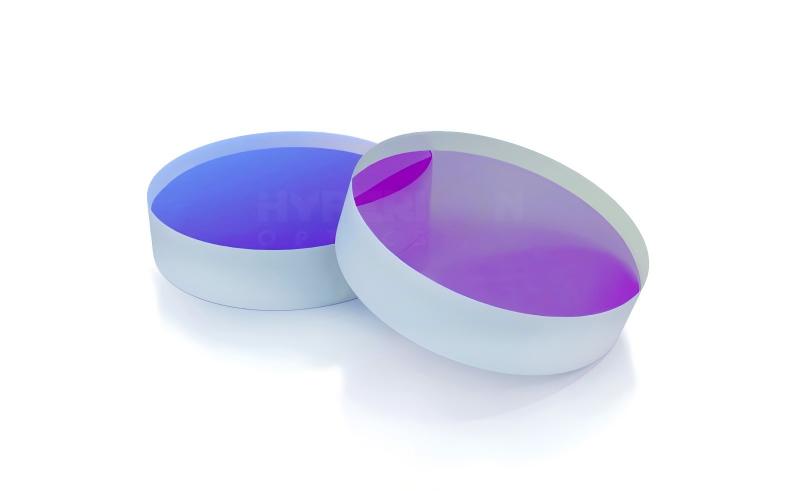
The versatility of dielectric mirror glass makes it an indispensable component across diverse high-tech sectors. Because these mirrors can be engineered to handle high energy densities and specific wavelength requirements, they are utilized in the following key applications:
High-Power Laser Systems: Due to their ability to achieve reflectivity exceeding 99.9%, these mirrors are essential for beam steering and cavity optics in high-energy laser applications.
Precision Imaging and Astronomy: Mirrors with high surface flatness, such as $\lambda/10$, are critical for minimizing wavefront distortion in demanding imaging and astronomical instrumentation.
Scientific Instrumentation: From UV-based diagnostics down to 180nm to NIR and IR-based sensing, these mirrors facilitate precise light manipulation in a wide array of laboratory equipment.
Projection Technologies: Because they can be manufactured in large sizes up to 1000mm, specialized dielectric-coated substrates are frequently deployed in professional projection and large-scale display applications.
Optical Communications: Multi-channel variants of these thin-film components are used for wavelength division multiplexing (WDM) and signal routing, enabling more compact and cost-effective communication architectures.
Bioengineering and Medical Diagnostics: These mirrors and filters are vital for fluorescent microscopy and point-of-care diagnostic devices, where specific spectral extraction is required for biological sample analysis.
When undertaking a dielectric mirror glass design, the engineering team must balance several complex variables to meet the strict environmental and performance specifications required by modern optical systems. Precision is not merely a goal; it is a fundamental requirement of the design process.
The engineering team begins by defining the target spectral range, which dictates whether the mirror must perform in UV, Visible, NIR, or FIR wavelengths. This ensures the thin-film coating stack is perfectly optimized for the intended light source. Closely tied to this is the calculation of the Angle of Incidence (AOI). Since optical performance shifts significantly based on the angle at which light strikes the surface, engineers must meticulously account for these variances to guarantee performance consistency across the entire optical assembly.
Furthermore, high-precision applications—such as those found in astronomy or interference lithography—demand exceptional substrate flatness, often reaching levels like 1/10 wavelength. Achieving this level of flatness is essential to minimize wavefront distortion. Finally, for high-energy laser systems, the mirror must be designed to withstand significant thermal loads without degradation. Through superior dielectric mirror glass design, we ensure that these components maintain their integrity even under the most demanding conditions.
Selecting the right mirror requires a clear understanding of the trade-offs. The following table highlights why our clients frequently choose dielectric mirror glass for demanding industrial and scientific environments:
| Feature | Dielectric Mirror | Metallic Mirror (Al/Ag) |
|---|---|---|
| Reflectivity | Up to 99.9%+ | Typically 94% - 97% |
| Durability | High (Hard, scratch-resistant) | Moderate (Easily oxidized) |
| Spectral Control | Highly selective | Broadband but fixed |
| Stability | Excellent in air | Requires overcoats |
| Best For | High-power Lasers | General illumination |
At Hyperion Optics, we provide full-cycle engineering support with over 17 years of experience. Our expertise in dielectric mirror glass design is backed by a commitment to rigorous metrology.
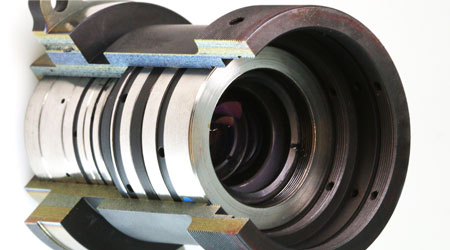
We ensure that the mirror housing and optical coating work in harmony to maintain thermal stability. Our engineering team integrates optical and mechanical designs to ensure the final solution meets all specified mechanical and performance requirements.
Our thin-film department specializes in custom coating stacks, including enhanced aluminum and dielectric 99% coatings, to match specific laser lines or imaging requirements. We provide a broad range of coating options, such as anti-reflective, high reflective, dielectric, BBAR, and dual-wavelength coatings.
We employ Zygo® interferometers and Trioptics® MTF testing stations to ensure every batch meets your specifications. Our manufacturing and quality assurance processes include 100% testing of all optical specifications, with complete inspection data and a Certificate of Compliance (COC) provided for each production batch.
The selection and design of high-quality optics are fundamental to the success of any photonics project. By choosing the right dielectric mirror glass, you ensure maximum light throughput, superior signal-to-noise ratios, and long-term reliability in your instruments.
At Hyperion Optics, we combine world-class engineering with a deep understanding of thin-film physics to deliver mirrors that perform exactly as intended.
If you are ready to explore our standard offerings, we invite you to view our complete mirror product catalog here.
For projects requiring custom specifications or specialized engineering, please contact our technical sales team today for a free consultation regarding your dielectric mirror glass design requirements. Let’s turn your optical challenges into competitive advantages.
Dielectric mirrors provide significantly higher reflectivity (>99.9%) and superior durability. Because they are constructed from hard oxide layers, they resist scratching and environmental degradation far better than soft metallic films.
Yes. Our expertise in dielectric mirror glass design allows us to optimize coatings for wavelengths ranging from UV (180nm) through the Visible, NIR, and into Far-Infrared.
We provide various precision grades tailored to specific application requirements, ensuring optimal performance and cost-efficiency:
λ/10 Precision: Designed for high-demand applications such as astronomy and advanced imaging, where minimizing wavefront distortion is critical.
λ/4 Precision: An ideal balance of quality and value for a wide range of scientific instruments.
1λ over 25mm Precision: A cost-effective solution specifically engineered for demanding imaging applications where image quality remains a priority.
We utilize quantitative metrology throughout the production cycle, including Zygo® interferometers and Trioptics® MTF testing stations. Every batch is delivered with full inspection data and a Certificate of Compliance (COC).




 Call us on:
  Email us:
  9B-4F, No.1 Qingnian Road Liando U Valley,Yuhua International Wisdom Valley, Nanjing, 210039 China