 English
  cn
cn  de
de  es
es  fr
fr 
Calcium Fluoride (CaF2) is often regarded as a cornerstone material in optics, celebrated for its remarkable optical properties and broad transmission range. Whether you're an optical engineer designing laser systems, a physicist working with spectroscopy, or a specialist in R&D, understanding the transmission properties of CaF2 is critical to optimizing performance across different applications.
In this comprehensive guide, we'll explore the unique transmission characteristics of CaF2, the factors influencing its performance, and why Hyperion's expertise makes us a trusted partner for high-quality CaF2 optics.
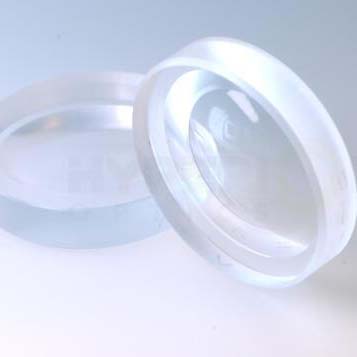
Calcium Fluoride offers an impressive transmission range from 180 nm to 8.0 µm, spanning the vacuum ultraviolet (VUV), visible (VIS), and infrared (IR) spectrums. With its capability to handle this expansive wavelength range, CaF2 has become a go-to material for demanding multi-spectral applications. Its industry moniker "holy grail" is well-deserved for both this versatility and high performance.
Hyperion specializes in manufacturing precision-engineered CaF2 lenses, offering unparalleled transmission properties. Our lenses are not just defined by the base material but are precisely optimized for superior functionality through rigorous quality control and advanced anti-reflection (AR) coatings. Let's delve deeper into the science behind CaF2 transmission and its unparalleled utility.
One of Calcium Fluoride's outstanding properties is its exceptional transmission in the vacuum ultraviolet (VUV) region, where it can effectively transmit wavelengths as short as 193 nm. This unique feature makes it indispensable in applications like excimer lasers, commonly used in semiconductor lithography and laser eye surgeries.
On the other end of the spectrum, CaF2 performs effectively in the mid-wave infrared (MWIR, 3–5 µm) but begins to exhibit some absorption as wavelengths approach the 8–10 µm range. Beyond 8 µm, its transmission capabilities decline, making it unsuitable for long-wave infrared (LWIR) applications.
Uncoated CaF2 optics can achieve a transmission rate of over 90% between 250 nm and 7 µm, with some variability dependent on material purity. It’s essential to consider both internal transmission, which is affected by material quality, and external transmission, which considers reflection losses due to Fresnel effects.
Although CaF2’s low refractive index (approximately 1.43) naturally minimizes reflection losses, anti-reflection (AR) coatings are critical for further enhancement. These coatings are engineered to significantly reduce surface reflectivity and increase overall transmission at specific wavelengths.
At Hyperion, we offer customized multi-layer AR coatings tailored to optimize the optical transmission of CaF2 lenses for targeted applications. Customers can achieve near 99% transmission for specific laser wavelengths, making our lenses an excellent choice for high-precision systems.
To help engineers and optical designers make informed choices, here's how Calcium Fluoride compares with other commonly used optical materials:
| Material | UV-VIS Range | IR Range | Advantages | Disadvantages |
|---|---|---|---|---|
| CaF2 | 180–8.0 µm | 0.2–8.0 µm | High damage threshold, low dispersion, broad transmission range | Expensive, brittle |
| BaF2 | 200–12 µm | 0.3–11 µm | Wider IR range | Less moisture resistant than CaF2 |
| Fused Silica | 185–2.5 µm | 0.2–2.5 µm | Excellent UV-VIS range, low thermal expansion | Limited IR transmission |
| ZnSe | Limited | 0.6–20 µm | Superior IR transmission | Lower durability, significant weight |
CaF2 outshines most materials when broad-spectrum transmission is needed, particularly when both UV and IR performance are critical.
Understanding the physical and environmental properties of CaF2 is crucial when designing high-performance optical components.
Calcium Fluoride is prized for its low thermal expansion coefficient and high thermal conductivity. These make it a preferred material for applications requiring dimensional stability under fluctuating temperatures.
One consideration with CaF2 is its brittle nature. It is prone to cleavage and thermal shock, making it essential to handle with care during manufacturing and application. Hyperion’s rigorous quality control ensures optimal material handling to prevent these issues.
While CaF2 is technically "hygroscopic" (able to absorb moisture), it has superior moisture resistance compared to hygroscopic materials like Sodium Chloride (NaCl) and Potassium Bromide (KBr). This makes it better suited for environments with higher humidity.
Given its versatility and performance, CaF2 is used in a variety of high-precision industries, including:
Its transmission properties across UV and IR wavelengths make CaF2 the material of choice for FTIR spectrometers and other optoelectronic instruments.
CaF2 plays a critical role in laser-assisted surgical systems, medical diagnostic devices, and high-end laser optics requiring excellent UV transmission.
CaF2 optics are widely used in thermal imaging systems and space-grade, cryogenically cooled applications due to their broad spectral response and durability.
At Hyperion, we combine expertise, precision engineering, and cutting-edge technology to deliver industry-leading CaF2 lenses and optical components. Here’s why our customers trust us:
Superior Quality Control: Every lens is thoroughly tested using advanced interferometry and spectrophotometry techniques to ensure the delivered product precisely matches the published specifications.
Custom Coatings: From VUV to IR, our AR coatings are tailored to maximize efficiency and help you achieve unmatched performance.
Engineering Excellence: With years of experience in the field of IR lens fabrication, including high-damage-threshold coatings, our engineers are experts in solving the toughest challenges.
Calcium Fluoride (CaF2) remains an indispensable material for multi-spectral optical systems, with its outstanding transmission properties ranging from ultraviolet to infrared wavelengths. Whether you're involved in semiconductor manufacturing, medical imaging, spectroscopy, or defense applications, choosing the right CaF2 optics is crucial for achieving top-tier performance.
At Hyperion, we set the standard in CaF2 lens fabrication, offering tailored solutions to meet your precise requirements. Ready to elevate your optical systems with extraordinary transmission properties?
Contact Hyperion’s engineering team to discuss your project and request a custom CaF2 optical solution.



 Call us on:
  Email us:
  9B-4F, No.1 Qingnian Road Liando U Valley,Yuhua International Wisdom Valley, Nanjing, 210039 China