 English
  cn
cn  de
de  es
es  fr
fr 
In 2026, advancements in thermal imaging, medical diagnostics, and defense technologies demand precise and durable optical materials. For applications like drone-based thermal sensors or surgical lasers, choosing the right infrared (IR) window or lens is essential. But does your project require the optical precision of a zinc selenide (ZnSe) window or the rugged durability of zinc sulfide (ZnS)?
In this guide, we’ll break down the critical differences between ZnSe and ZnS, explain their unique strengths, and help you determine which material is best suited to your application. Whether you’re an optical engineer, defense contractor, or medical device developer, understanding these materials is pivotal to achieving optimal performance.
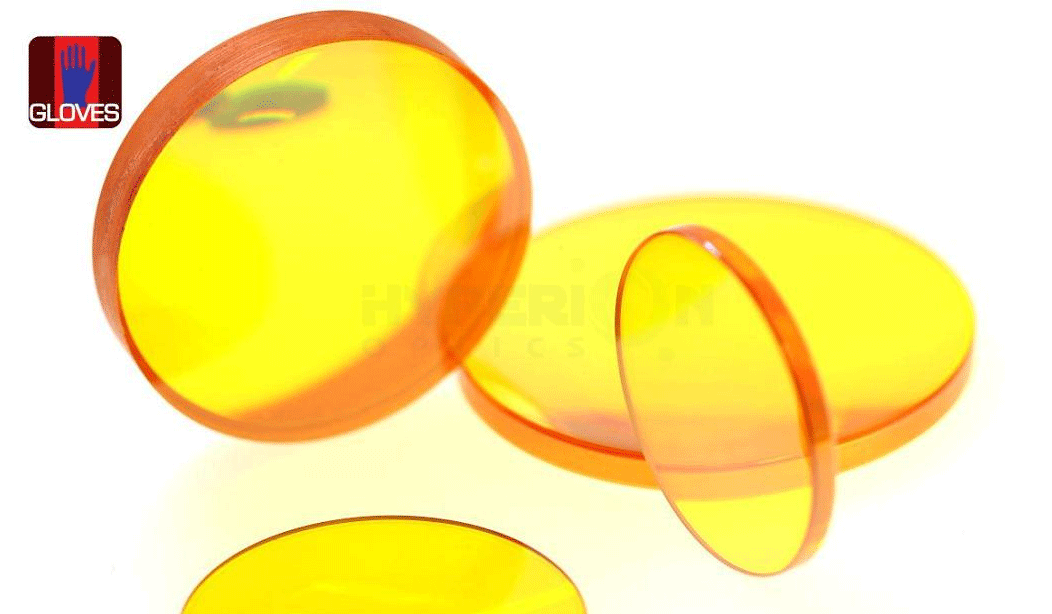
Zinc selenide, known for its chemical vapor deposition (CVD) production process, is an indispensable material in modern optical systems. Thanks to its low absorption coefficients and wide transmission range, ZnSe lenses and windows are relied upon in precision applications where optical clarity is paramount.
Superior Infrared Transparency: ZnSe demonstrates excellent transmission across 0.5–22 microns, making it ideal for long-wave infrared (LWIR) systems and high-power CO2 lasers.
Low Refractive Index Variability: Its stable refractive index ensures minimal distortion in high-precision optical systems.
Thermal Properties: ZnSe can handle high energy densities, commonly found in medical lasers and high-power optical systems.
CO2 Laser Optics: High-power lasers in industrial and medical sectors require materials like ZnSe due to its superior transmittance and low thermal absorption.
Thermal Imaging: Frequently used in IR thermal diagnostics in healthcare for non-invasive surgeries and imaging.
Spectroscopy: ZnSe finds application in mid-IR spectroscopy where chemical analysis relies on precise detection of wavelengths.
Did you know? In its uncoated form, ZnSe has a naturally high reflectance. Hyperion Optics specializes in applying anti-reflective (AR) coatings, enhancing its already stellar optical properties.
While ZnSe excels in transmittance, zinc sulfide stands out for its mechanical durability. This makes ZnS, especially its multispectral (Cleartran) form, ideal for systems operating in harsh environmental conditions such as aerospace and marine defense.
Hardness and Impact Resistance: The durable structure of ZnS allows it to withstand rain, wind-blown debris, and temperature fluctuations, making it invaluable for outdoor systems.
Multispectral ZnS (Cleartran): This advanced variation of ZnS extends its transmissive range across the visible to mid-IR spectrum, offering enhanced clarity for multi-band imaging systems.
Temperature Resistant: ZnS demonstrates better thermal shock resistance compared to ZnSe, tolerating faster temperature changes.
Defense Systems: Aircraft, UAVs (unmanned aerial vehicles), and marine systems rely on ZnS for robust thermal imaging windows and FLIR systems.
Hyperspectral Imaging: Multispectral ZnS’s wide transmission range makes it optimal for scenarios requiring cross-spectrum imaging clarity.
Harsh Environment Optics: Coated ZnS excels in withstanding exposure to salt spray, sand abrasion, and extreme temperatures in defense deployments.
Selecting between ZnSe and ZnS depends on your application’s precise requirements. Here’s a quick comparison:
| Property | Zinc Selenide (ZnSe) | Zinc Sulfide (ZnS) |
| Transmission Range | 0.5–22 microns | Visible–12 microns (Multispectral ZnS: visible to mid-IR) |
| Refractive Index | Lower, more stable | Slightly higher |
| Thermal Shock Resistance | Adequate | Higher tolerance |
| Hardness | Softer | Higher (Knoop Hardness: 160-240) |
| Environmental Durability | Lower resistance to abrasion | High resistance to environmental stress |
| Applications | High-power lasers, medical devices | Defense, aerospace, UAV systems |
ZnS is typically more cost-effective compared to ZnSe for standard-grade materials. However, the advanced properties of multispectral ZnS can make it comparable in price to ZnSe.
As non-invasive surgeries become the standard in 2026, demand for precision ZnSe lenses in thermal diagnostic tools and surgical lasers continues to rise. Medical systems leveraging ZnSe’s transparency in IR wavelengths ensure safer and more accurate procedures.
Next-generation UAVs and FLIR systems require a perfect balance between performance and durability. Multispectral ZnS, with its superior impact resistance and broad-spectrum visibility, has become a favorite for drones operating in rugged environments. Meanwhile, ZnSe remains the material of choice for applications requiring peak IR clarity, such as targeting systems.
Selecting the right material is only part of the equation. The true performance of ZnSe or ZnS depends heavily on the coatings applied. Hyperion Optics offers anti-reflective (AR) coatings, as well as scratch-resistant diamond-like carbon (DLC) coatings, tailored to specific applications. For example:
Defense Applications: DLC coatings provide durability against rough environments.
Medical Systems: AR coatings improve system efficiency by reducing reflection-induced losses.
To summarize:
Use ZnSe when optical clarity, low absorption, and high transmittance in the IR spectrum are crucial for precision performance.
Opt for ZnS in conditions where durability, impact resistance, and environmental resilience take priority.
Choosing the right IR material is a complex but critical decision in fast-evolving defense and medical landscapes. At Hyperion Optics, we combine material expertise with cutting-edge coating technologies to ensure your optical components meet the highest standards of performance and resilience.
Unsure which material fits your needs? Explore Hyperion’s Precision Zinc Selenide Windows or contact our optical engineers for a custom quote and coating simulation.
Q: What is the main advantage of ZnSe over ZnS?
A: ZnSe offers superior transmittance and lower absorption in the 0.5-22 micron range, making it ideal for high-accuracy IR applications like CO2 lasers.
Q: What is Multispectral ZnS?
A: Multispectral ZnS, also known as Cleartran, is an advanced form of ZnS with improved transmission across visible to mid-IR wavelengths, useful for multi-band imaging in harsh conditions.
With Hyperion Optics’ expertise, you can optimize performance for 2026 and beyond. Whether you’re developing next-gen medical devices or defense-grade thermal systems, precision begins with the right material and finishes with the right partner.




 Call us on:
  Email us:
  9B-4F, No.1 Qingnian Road Liando U Valley,Yuhua International Wisdom Valley, Nanjing, 210039 China